
HOSPICE CARE
All Care Hospice is about living life to the fullest, everyday, in comfort. The goal of hospice care is to enhance the quality of a person’s life, while optimizing the time spent with family and friends.
Hospice support empowers patients to live with dignity, grace and fulfillment. With a focus on caring, not curing, patients receive services wherever they call home, which is often in their home, a nursing home, hospital, or residential facility.

Hospice Care Referrals
- 781-598-7066
- 781-598-3571
Interdisciplinary Care Team
Our team of nurses, home health aides, social workers, chaplains, and volunteers work with the patient’s physician and our Medical Director to provide physical, emotional and spiritual support for the patient and family.
Hospice care is available 24 hours-a-day, seven days-a-week. Most importantly, All Care Hospice offers patients and families control over the final aspects of their lives, ensuring their last days are lived on their own terms, with their wishes respected, their decisions enforced and their dignity assured.

Nursing
Care focused on providing compassionate care to patients who are nearing the end of life.

Home Health Aides
Personal care and support to patients who are receiving services.

Medical Social Work
Support focused on the emotional, social, and practical needs of patients and families.

Spiritual Support
Emotional, spiritual, and sometimes religious care provided to patients and their families.

Volunteers
Support and respite for patients and families that ensures comfort, dignity, and emotional support

Grief & Loss Support
Emotional and psychological care provided to family members and loved ones after the death of a patient.
What Hospice Care Includes

Medications
All medications related to the terminal illness.
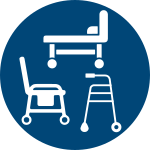
Medical Equipment
Medical equipment such as hospital bed and oxygen.

Education
Patient and caregiver education on what to expect with hospice.
Specialty Programs

Congestive Heart Failure
Program focusing on managing symptoms like shortness of breath, fatigue, and fluid buildup to maximize comfort and quality of life during the end stages of the disease.

Dementia Sensory Interventions
Program that uses sensory activities to stimulate the brain and improve the quality of life for people with dementia.

Dementia Support for the Caregiver
Dementia caregiving can be physically, emotionally, and mentally demanding, especially as the disease progresses and end-of-life care becomes a priority. Program offers resources to ease the burden on caregivers.
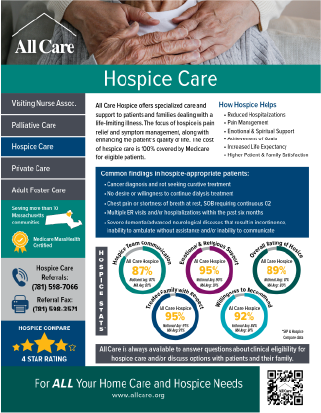
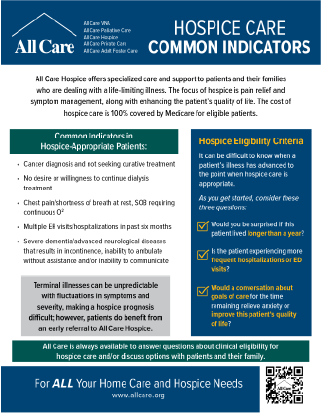
Hospice Eligibility
Your doctor certifies that you have a terminal illness, with six months or less to live if the disease runs its normal course.
You're ready to stop treatments to cure your illness, instead focusing on treatments that improve your comfort and quality of life.
Your hospice provider is certified by Medicare/Medicaid.
Common Hospice Illnesses
Cancer
Heart Disease
Kidney Disease
Lung Disease
Alzheimer's & Dementia
Liver Disease
All Care Service Area

Allston
Amesbury
Andover
Arlington
Bedford
Belmont
Beverly
Billerica
Boxford
Brighton
Brookline
Burlington
Byfield
Cambridge
Charlestown
Chelmsford
Chelsea
Danvers
Dracut
East Boston
Essex
Everett
Georgetown
Gloucester
Groveland
Hamilton
Haverhill
Ipswich
Jamaica Plain
Lawrence
Lexington
Lowell
Lynn
Lynnfield
Malden
Manchester-by-the-Sea
Marblehead
Medford
Melrose
Merrimac
Methuen
Middleton
Nahant
Newbury
Newburyport
Newton
North Andover
North Reading
Peabody
Plum Island
Reading
Revere
Rockport
Rowley
Salem
Salisbury
Saugus
Somerville
Stoneham
Swampscott
Tewksbury
Topsfield
Wakefield
Waltham
Watertown
Wenham
West Newbury
Wilmington
Winchester
Winthrop
Woburn
Dispelling Hospice Myths
Hospice is only for the last few days of life.
Hospice can begin when a person has a terminal illness and is expected to live six months or less, according to MD prognosis. It’s not limited to the final days, and early involvement can provide valuable support/ symptom management for both the patient and family.
Hospice is only for those who live in a special facility/hospice house.
Hospice care can be provided in various settings, such as the patient’s home, nursing homes, assisted living facilities, or even hospitals. The care is designed to meet the patient’s preferences and needs, wherever they feel most comfortable.
Hospice care is expensive and not covered by insurance.
Hospice care is typically covered by Medicare, Medicaid, and most private insurance plans. It generally includes medical care, medications related to the terminal illness, nursing care, and emotional support at little to no cost to the patient or family.
Hospice care is only for cancer patients.
Hospice care is for anyone with a terminal illness, not just cancer. It can be provided for patients with heart disease, lung disease, dementia, kidney failure, neurodegenerative diseases, and more.
Hospice care is only for the patient, not the family.
Hospice care includes extensive support for families, including emotional counseling, spiritual care, respite care, and grief support after the patient’s passing. The goal is to support both the patient and their loved ones during this difficult time.
Hospice means giving up on medical treatments.
Hospice care focuses on comfort rather than curative treatments. However, patients can continue to receive medications and treatments to manage symptoms like pain, nausea, infections and difficulty breathing.
It is the doctor’s responsibility to bring up hospice.
While doctors play a key role in the decision to pursue hospice care, it is not solely their responsibility to bring it up. Hospice care should be a conversation that involves the patient, their family, and the entire health care team.
Once the choice is made for hospice care, there is no turning back.
Hospice care is voluntary and can be discontinued if the patient’s condition improves or if they decide to pursue curative treatments again. The decision to begin hospice is not irreversible.
Hospice care requires a Do Not Resuscitate (DNR) order.
A DNR order is not a requirement for hospice care. While many hospice patients choose a DNR to avoid aggressive life-saving measures, it is ultimately the patient’s or family’s choice. Hospice care is about respecting the patient’s wishes.
All hospices are the same.
Hospice organizations may offer varying levels of care, resources, and approaches to treatment. It’s important to choose a hospice that aligns with the patient’s and family’s needs, whether it’s specialized services, emotional support, or specific care types.
Hospice care is only for the very old.
Hospice care is for people of all ages, including children and young adults, as long as they have a terminal illness. There are even specialized pediatric hospice programs to meet the unique needs of children and their families.
Hospice care and palliative care are the same thing.
Hospice care and palliative care are related, but they are not the same thing. Both focus on providing comfort and improving the quality of life for individuals with serious illnesses, but there are key differences in their goals, timing, and approach.
Hospice care ends with the patient's passing.
Hospice care includes bereavement support for families after the patient’s death. Grief counseling, emotional support, and resources are provided for up to a year to help loved one’s cope with their loss.
Hospice is the same as euthanasia.
Hospice care is not about hastening death. It focuses on providing comfort and improving quality of life in the final stages of life. Euthanasia, on the other hand, involves intentionally ending a life, which is not part of hospice care.
Morphine hastens death.
Morphine, when used in hospice to manage pain and symptoms, does not hasten death. It is used to provide comfort, and while it can slow respiratory function at high doses, it is administered carefully to manage symptoms without accelerating death.
Hospice takes over caregiving and is in the home 24 hours a day.
Hospice does not provide around-the-clock bedside care, nor does it replace caregiving provided by loved ones, nursing home staff , or other residential care. Hospice is supportive care and is designed to assist with education and symptom management.
Hospice stops all medications upon admission.
Hospice does not stop all medications upon admission. Stopping medication is more of a conversation between the attending physician, hospice doctor, and patient/family. The hospice team carefully evaluates which medications are still beneficial for comfort and quality of life.
All Care Hospice Outcomes
We value the voices of our patients’ families. Medicare’s Hospice Family and Caregiver Survey gathers feedback from those closest to our patients to understand their experiences with our care. The survey focuses on communication, symptom management, emotional and spiritual support, and overall satisfaction. Results help us continuously improve our services and ensure we provide compassionate, high-quality care every step of the way.
It is all the work that went into these outcomes that earned All Care Hospice a 5 Star Rating! A 5 Star Rating shows that a hospice is not just providing care, but providing highly reliable, compassionate, and effective care that families notice and appreciate. It’s a mark of trust, quality, and excellence in end-of-life care.
All Care Hospice Family & Caregiver Survey Outcomes
The Hospice Family Caregiver Survey asks family members or friends about the patient's hospice care, and if they would recommend that hospice to someone else.

Getting Timely Care
85% of families report that All Care Hospice provided timely care.
Hospice Team Communication
90% of families reported that the All Care Hospice team provided great communication.
Treating Families Members with Respect
100% of families reported that All Care Hospice treated family members with respect.
Getting Help for Symptoms
83% of families reported that their loved one was receiving help for their symptoms.
Getting Emotional & Spiritual Support
99% of families reported that All Care Hospice offered emotional & spiritual support.
Getting Hospice Training
89% of families reported that All Care Hospice provided them with training.
Care Preferences
100% of families reported that All Care Hospice adhered to their care preferences.
Overall Rating
87% of families gave All Care Hospice a 9 or 10 rating on a scale of 1-10.
Willingness to Recommend
97% of families reported they would recommend All Care Hospice... which is the best outcome of all!
5-Star Medicare Rating!
All Care Hospice earned a 5 Star Rating from Medicare based on quality outcome scores!
All Care Hospice: Raising the Bar in Hospice Care
All Care’s outcomes from the Patient and Caregiver Survey far exceed other Massachusetts hospice providers.

What Our Hospice Families Are Saying
The help and support I received from my husband’s hospice nurse was beyond helpful and beyond my expectations. Everyone at All Care was wonderful and I could not have been more grateful.
Patricia
Hospice Family Member
After years of having little to no control over her daily living, All Care Hospice gave my mom the gift of agency over her body one last time. Because of them, we were able to honor her wish to live out her final days at home, rather than in a hospital bed. She was able to die with dignity and grace. There is no greater gift.
Sue
Hospice Family Member
The hospice nurse took amazing care of my wife. Her patience, calmness, and expertise made this very difficult time so much better. I will never forget what she did for our family along with everyone else involved in her care.
James
Hospice Family Member

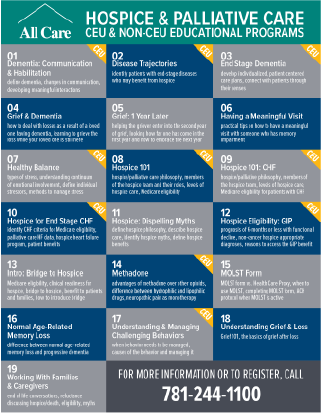
Hospice & Palliative Care Educational Programs
All Care offers a wide range of educational programs led by experienced hospice professionals to educate clinicians and caregivers on the benefits (and challenges) of hospice. Many programs offer contact hours (CEU) for eligible clinicians.
Send Us a Message
Please do not include any Personal Health Information in this form (diagnosis, medications, member/patient ID, Medicare or Medicaid number, social security number). If you wish to discuss such items, call our office at 781-598-7066.